
Entangled Networks: Enabling Technologies and Future Markets
Published September 2026
A New Market Is Taking Shape
Today’s commercial entangled-network market is centered on entangled-photon sources, single-photon detectors, precision timing and stabilization systems, network-control software, and prototype networking equipment. But this is only the starting point.
Unlike reports that treat the quantum internet as a distant scientific vision, CIR examines the technologies and applications that are already turning entanglement-based networking into a genuine business opportunity.
The report analyzes critical enabling technologies—including quantum repeaters, quantum memories, entangled-photon sources, detectors, transducers, control systems, and networking software—and assesses how their development will shape the market over the coming decade.

Post-Quantum Cryptography 2026: The Age of Deployment
Published August 2026
This 200 page report examines the rapidly expanding market for quantum-safe cybersecurity technologies as enterprises, governments, and critical infrastructure operators prepare for the arrival of Cryptographically Relevant Quantum Computers (CRQCs). While estimates vary, many experts now place “Q-Day,” the point at which quantum computers can break today’s public-key cryptography, within the 2030-2035 timeframe. Because cryptographic migrations can take many years to complete, organizations are increasingly recognizing that the transition to post-quantum security must begin immediately.

Quantum Drug and Materials Design: Use Cases and Market Forecasts: 2026-2035
Published June 2026
Quantum computing is reshaping future pharmaceutical research and advanced materials design. This sector remains at an early stage; but with real-world demonstrations on quantum hardware are underway, with leading pharmaceutical, chemical, automotive, and aerospace firms exploring how quantum systems can accelerate discovery, simulation, and optimization.
At CIR, we track the companies, technologies, partnerships, and algorithms driving this transformation. Our research examines how hybrid quantum-classical workflows are being used today for molecular simulation, catalyst development, battery chemistry, computational fluid dynamics, next-generation materials engineering and other strategically vital areas.
Markets for Photonic Quantum Computers
Published May 2026
Our primary goal in this report is to analyze and quantify the commercial potential for quantum computers that use photonics for their main fabric. There are perhaps 15 models of such machines being commercialized at the present time with PsiQuantum having attracted the largest funding to date and Xanadu attracting considerable attention, too. But there are others as we report in this document, inevitably not as well known as PsiQuantum and Xanadu.
Of the serious contender technologies for quantum computers, photonic quantum computers seem the most “edgy” in that they (1) are the most strongly associated with measurement-based quantum computers (MBQCs) with their apparent path to significantly improved error correction and (2) offer a “natural path” to advanced quantum networks.
Quantum Computer Markets: Who Leads?
Published April 2026
In this report we provide 13 strategic profiles of distinguished firms around the world working to provide the quantum computer market with full-stack quantum computers and compare them according to a new rating scheme we constructed. Our assessment approach scheme is unique in that it takes into consideration more than just technical benchmarking and appraises the companies considered on other factors that are just as important to long-term business success.

AI Factories: The Emerging Industrial Infrastructure for Artificial Intelligence
Available September 2026
This report examines the transformation of AI infrastructure from the server-based data centers of today into integrated production systems designed to “manufacture” computational intelligence at scale. AI factories take a completely new direction. Rather than treating an AI factory simply as a very large GPU cluster, this report analyzes it as a new computing architecture in which semiconductors, high-bandwidth memory, advanced packaging, networking, storage, software, electrical infrastructure and cooling planned together. Although a growing number of large firms are involved in the birthing of AI Factories, NVIDIA is understandably and especially enthusiastic – AI factories may contain as many as millions of GPUs. NVIDIA’s current Rubin architecture illustrates the direction in which the AI factory is pointing.



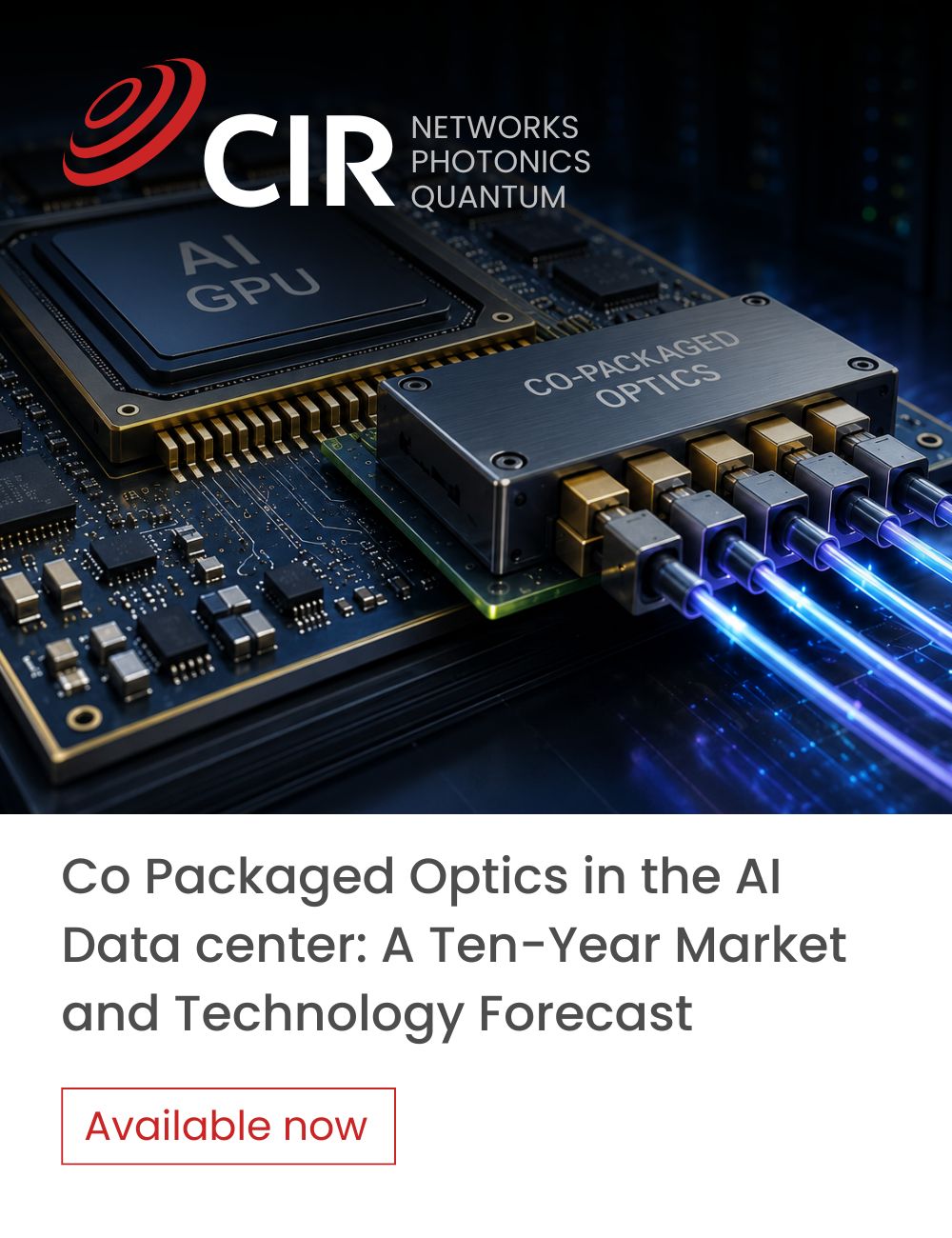
Co-Packaged Optics in the AI Data Center: A Ten-Year Market and Technology Forecast
Published January 2026
This report explores the future of co-packaged optics (CPO) and related technologies as an interconnect technology for AI data centers. It includes granular forecasts of CPO shipments taking into consideration realistic time frames for the commercial development of CPO. The forecasts are broken out in various ways including, data rate, standards/technology location in the network (data center interconnect, intra-rack and inter-rack). There are also strategic profiles of approximately 30 major influencer firms developing CPO products. Finally, the report devotes significant space to how end-users will optimally deploy CPO for AI in the next ten years both in the immediate future and how this will change as products and standards change.
Processors for HPC and AI
Available in June, 2026
High-performance computing (HPC) and AI are increasingly converging around accelerated, heterogeneous processors with each type of processor doing what it does best. For example, the latest platforms combine CPUs with GPUs, application-specific accelerators, high-bandwidth memory and advanced interconnects. The rapid growth of AI has made accelerators the principal source of industry expansion, while scientific computing, simulation, national labs and weather forecasting continue to support demand for conventional HPC systems. Meanwhile, the HPC and AI processor markets has become less distinct.
Contact Us Today